現在の小問:(a) /
1 / 2 問目
解説
## (a) 発電端効率
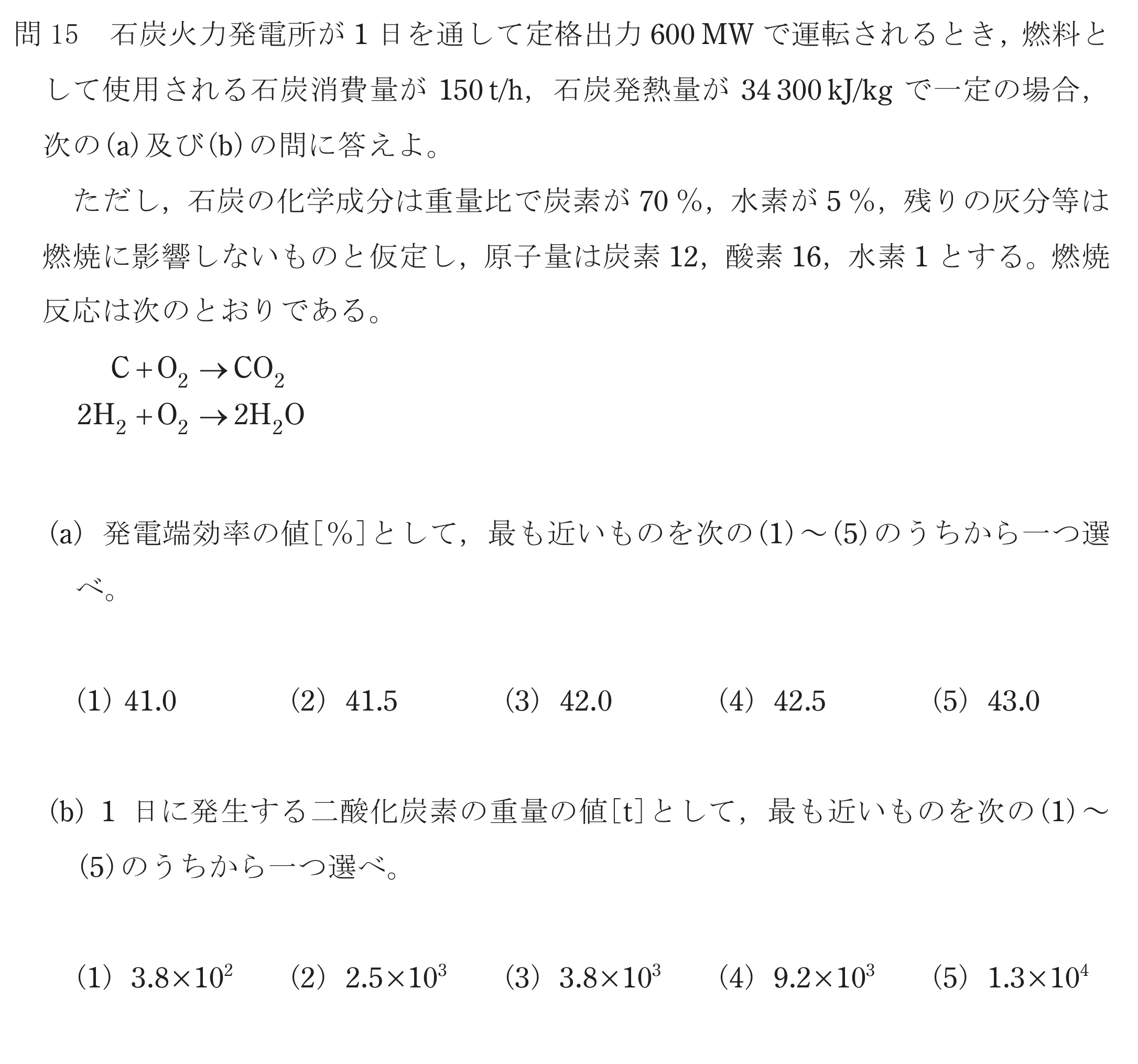
発電端効率は、燃料がもつ熱エネルギーに対して、発電機端で得られる電気エネルギーの割合です。
石炭消費量は \(150\ \text{t/h}=150000\ \text{kg/h}\)、発熱量は \(34300\ \text{kJ/kg}\) なので、1時間あたりの燃料投入熱量は
\[
150000 \times 34300=5.145\times 10^9\ \text{kJ/h}
\]
一方、定格出力は \(600\ \text{MW}=600000\ \text{kJ/s}\) です。1時間あたりの発電電力量は
\[
600000 \times 3600=2.16\times 10^9\ \text{kJ/h}
\]
したがって、発電端効率は
\[
\eta=\frac{2.16\times 10^9}{5.145\times 10^9}\times 100
\]
\[
\eta \fallingdotseq 42.0\ \%
\]
よって、(a) の正解は **(3)** です。
## (b) 1日に発生する二酸化炭素の質量
1日の石炭消費量は
\[
150\ \text{t/h} \times 24\ \text{h}=3600\ \text{t}
\]
石炭中の炭素は重量比で70%なので、1日に燃焼する炭素の質量は
\[
3600 \times 0.70=2520\ \text{t}
\]
燃焼反応は
\[
\mathrm{C}+\mathrm{O}_2 \rightarrow \mathrm{CO}_2
\]
です。炭素の原子量は12、二酸化炭素の分子量は \(12+16\times 2=44\) なので、炭素から二酸化炭素への質量比は
\[
\frac{44}{12}
\]
したがって、発生する二酸化炭素の質量は
\[
2520 \times \frac{44}{12}=9240\ \text{t}
\]
\[
9240\ \text{t}=9.24\times 10^3\ \text{t}
\]
最も近い値は \(9.2\times 10^3\ \text{t}\) です。
よって、(b) の正解は **(4)** です。
さらに調べる
現在の小問:(a) /
1 / 2 問目
解説
## (a) 発電端効率
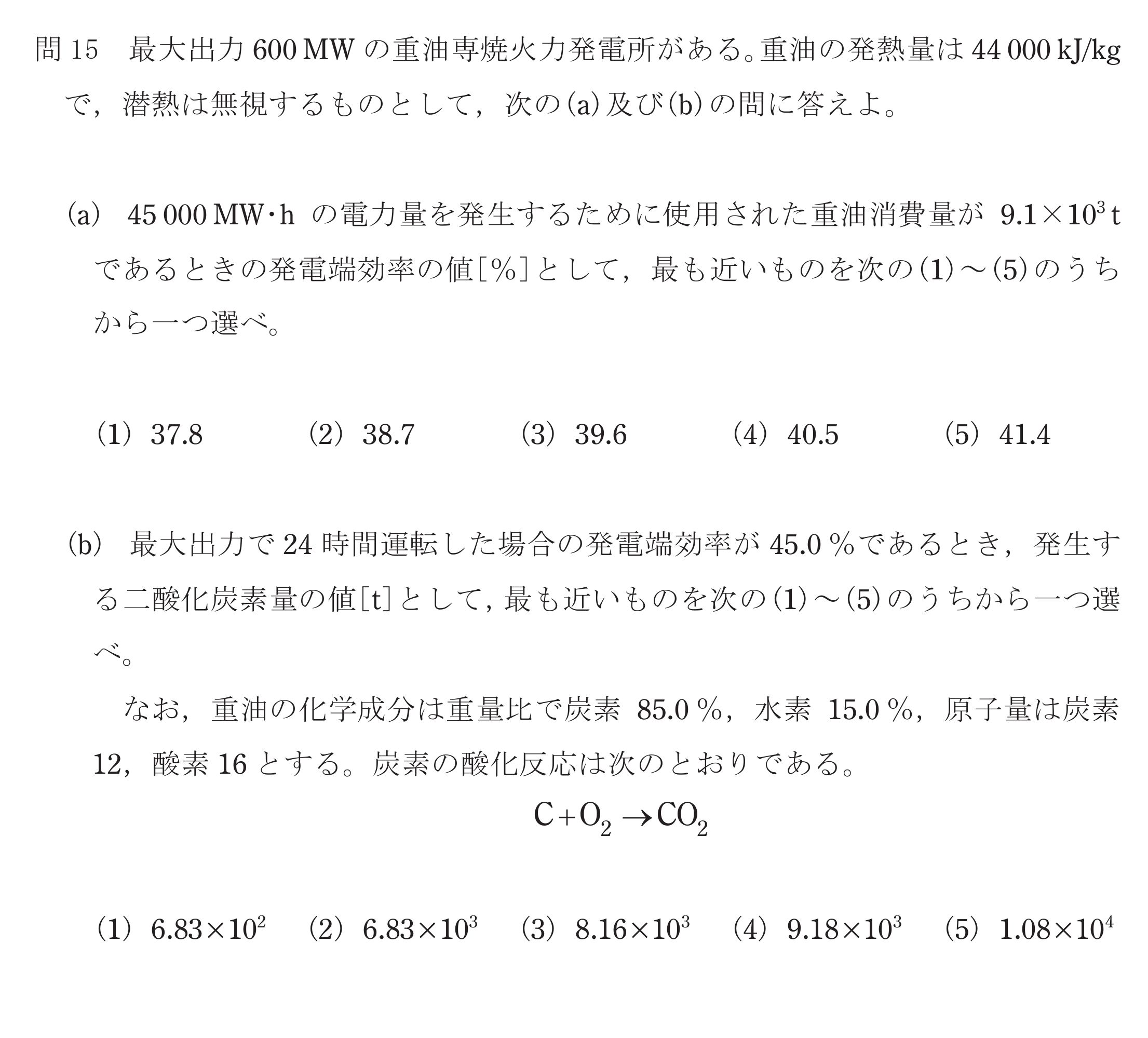
発電端効率は、燃料がもつ熱量に対する発電電力量の割合です。
発電電力量は
\[
45000\ \text{MW}\cdot\text{h}=45000\times 3.6\times 10^6\ \text{kJ}
\]
です。
燃料の投入熱量は、重油消費量が \(9.1\times 10^3\ \text{t}=9.1\times 10^6\ \text{kg}\) なので、
\[
9.1\times 10^6\times 44000=4.004\times 10^{11}\ \text{kJ}
\]
となります。
したがって、発電端効率は
\[
\eta=\frac{45000\times 3.6\times 10^6}{9.1\times 10^6\times 44000}\times 100
\]
\[
\eta\fallingdotseq 40.46\% \fallingdotseq 40.5\%
\]
よって、(a) の正解は **(4)** です。
## (b) 二酸化炭素発生量
最大出力 \(600\ \text{MW}\) で24時間運転したときの発電電力量は
\[
600\times 24=14400\ \text{MW}\cdot\text{h}
\]
です。
これを熱量に直すと、
\[
14400\times 3.6\times 10^6=5.184\times 10^{10}\ \text{kJ}
\]
です。
発電端効率が \(45.0\%\) なので、燃料の投入熱量は
\[
\frac{5.184\times 10^{10}}{0.45}=1.152\times 10^{11}\ \text{kJ}
\]
となります。
重油の発熱量は \(44000\ \text{kJ/kg}\) であるから、使用重油量は
\[
\frac{1.152\times 10^{11}}{44000}=2.618\times 10^6\ \text{kg}
\]
です。
重油中の炭素は重量比で \(85.0\%\) なので、炭素の質量は
\[
2.618\times 10^6\times 0.85=2.225\times 10^6\ \text{kg}
\]
です。
反応式
\[
\text{C}+\text{O}_2\rightarrow \text{CO}_2
\]
より、炭素 \(12\) に対して二酸化炭素 \(44\) が生成します。
したがって、二酸化炭素の質量は
\[
2.225\times 10^6\times \frac{44}{12}=8.16\times 10^6\ \text{kg}
\]
\[
=8.16\times 10^3\ \text{t}
\]
よって、(b) の正解は **(3)** です。
さらに調べる
現在の小問:(a) /
1 / 2 問目
解説
## (a)
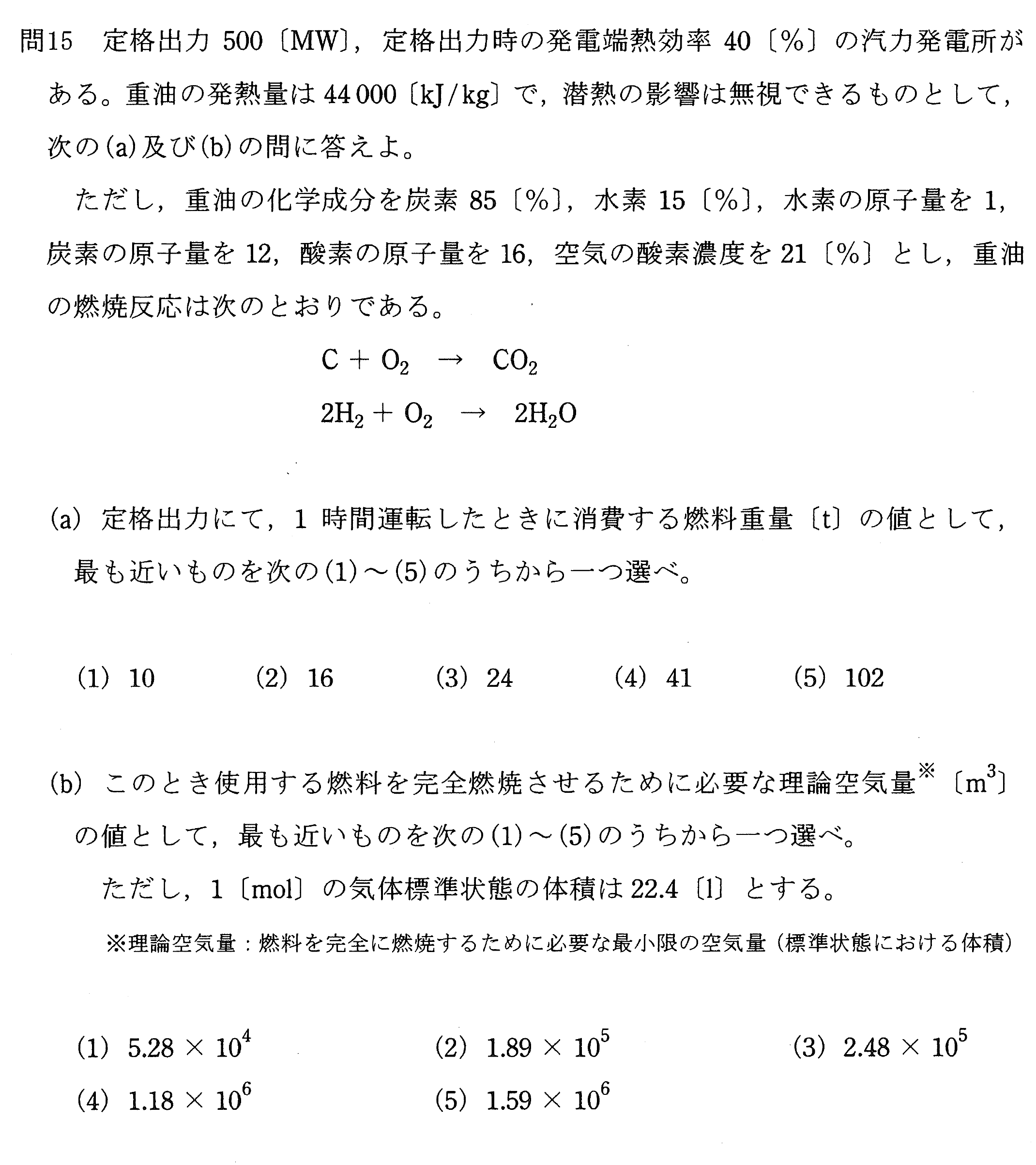
定格出力で1時間に発生する電力量は、
\[
500\,\mathrm{MW}\times 3600\,\mathrm{s}
=1.80\times10^6\,\mathrm{MJ}
\]
である。発電端熱効率は40 %なので、この電力量を得るために必要な燃料の発熱量は、
\[
\frac{1.80\times10^6}{0.40}
=4.50\times10^6\,\mathrm{MJ}
\]
となる。重油の発熱量は
\[
44\,000\,\mathrm{kJ/kg}=44\,\mathrm{MJ/kg}
\]
であるから、燃料重量は
\[
\frac{4.50\times10^6}{44}
=1.02\times10^5\,\mathrm{kg}
=102\,\mathrm{t}
\]
となる。よって、(a) は **(5)** です。
## (b)
(a)で求めた燃料重量を、計算値として
\[
W=1.0227\times10^5\,\mathrm{kg}
\]
とする。燃料中の炭素および水素の物質量は、それぞれ
\[
n_C=\frac{0.85W}{12}
\]
\[
n_H=\frac{0.15W}{1}
\]
である。ここで、炭素は \(\mathrm{C+O_2arrow CO_2}\) より、炭素1 kmol当たり酸素1 kmolを必要とする。
また、水素の燃焼では、水素原子4 kmol当たり酸素1 kmolを必要とするため、必要な酸素量は \(n_H/4\) である。したがって、必要な酸素量は
\[
n_{O_2}
=\frac{0.85W}{12}+\frac{0.15W}{4}
\]
\[
=\frac{0.85\times1.0227\times10^5}{12}
+\frac{0.15\times1.0227\times10^5}{4}
\approx1.108\times10^4\,\mathrm{kmol}
\]
となる。空気中の酸素濃度は21 %であるから、理論空気量の物質量は
\[
n_a=\frac{n_{O_2}}{0.21}
\approx5.28\times10^4\,\mathrm{kmol}
\]
である。標準状態における体積は、
\[
V_a=n_a\times22.4
\approx5.28\times10^4\times22.4
=1.18\times10^6\,\mathrm{m^3}
\]
となる。よって、(b) は **(4)** です。
さらに調べる